Prediction Markets: How They Work, What They Reveal, and Why Traders Should Pay Attention
Prediction markets have existed in various forms for decades, but 2024 and 2025 changed their status from niche curiosity to mainstream financial instrument. During the U.S. presidential election, platforms like Polymarket attracted hundreds of millions of dollars in volume and appeared to price the outcome more accurately than polling-based forecasts. Regulated platforms like Kalshi secured legal victories to offer event contracts to U.S. retail traders.
That trajectory is accelerating. Prediction markets are now a relevant data source for equity traders, macro analysts, and anyone trying to understand how the market prices future events.
This post explains how they work, how they interact with the broader stock market, and what risks they introduce for participants.
What Is a Prediction Market
A prediction market is a marketplace where participants buy and sell contracts tied to the outcome of future events. Each contract resolves at $1 if the event occurs and $0 if it does not.
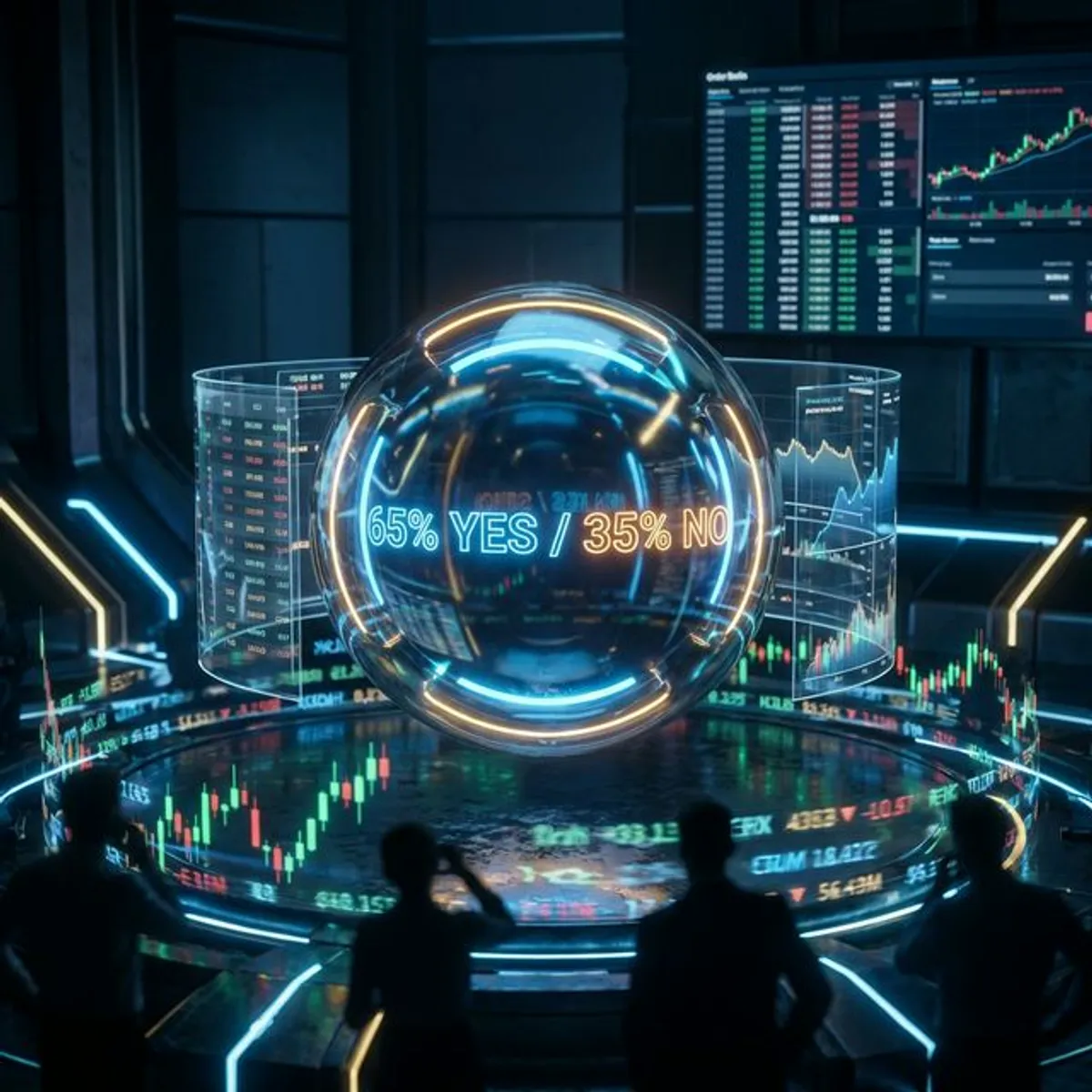
The market price of a contract reflects the collective probability the crowd assigns to that outcome.
Example: A contract asking “Will the Federal Reserve cut rates in March?” trading at $0.62 implies the market believes there is a 62% probability of a rate cut. If a cut happens, buyers collect $1 per contract. If not, sellers keep the premium.
This is fundamentally different from stock trading. You are not pricing earnings or cash flows — you are pricing the likelihood of a discrete event.
How Contracts Are Structured
Most prediction markets use a binary outcome structure:
- Yes contracts — pay out if the event occurs
- No contracts — pay out if the event does not occur
- Yes + No always sum to $1 — this is the arbitrage condition that keeps prices coherent
Some platforms also offer multi-outcome markets (e.g., “Which party wins the Senate seat?”) where contracts for each option sum to $1 across all outcomes.
Markets are resolved by a designated oracle — either an automated feed, a trusted third party, or a decentralized resolution protocol.
The Major Platforms
Polymarket
The largest decentralized prediction market by volume. Built on the Polygon blockchain, Polymarket allows global participation using USDC as collateral. It has no regulatory approval for U.S. users (officially), though enforcement has been inconsistent.
During the 2024 U.S. election, Polymarket handled over $3.7 billion in total volume, making it the most-traded prediction market in history.
Key characteristics:
- decentralized settlement via UMA’s Optimistic Oracle
- no KYC for most users (though restricted in U.S. and some other jurisdictions)
- broad market creation — politics, economics, crypto, sports, science
- liquidity provided by automated market makers (AMMs)
Kalshi
A U.S. CFTC-regulated prediction market that fought a legal battle to offer event contracts to retail U.S. traders. Kalshi won a landmark ruling in 2024 allowing it to list political event contracts, overturning a previous CFTC restriction.
Key characteristics:
- regulated under U.S. commodity law
- offers event contracts on Fed decisions, economic data, political outcomes
- real-money trading for U.S. retail participants
- more conservative market scope than decentralized alternatives
Manifold Markets
A play-money platform primarily used for forecasting practice and community prediction. Not relevant for financial positioning but widely used by forecasting researchers and rationalist communities.
PredictIt
A CFTC-approved research-oriented market that operated for years under an academic exemption, with strict limits on position sizes and user counts. Currently in a contested regulatory status.
How Prediction Markets Affect the Stock Market
This is the question that matters most for equity and macro traders.
1. Real-Time Probability Pricing
Prediction market prices update continuously based on new information, often before that information is reflected in equity prices. When a policy announcement, geopolitical event, or macroeconomic data release is approaching, prediction markets provide a probability estimate that traders on regulated exchanges can use as a signal.
An S&P 500 trader watching a “Will Congress pass the debt ceiling extension by Friday?” market at 80% is getting a probability assessment that can directly inform position sizing and hedging decisions.
2. The “Smart Money” Effect
On highly liquid prediction markets, large bettors with genuine information advantages can move prices. Studies of Polymarket’s 2024 election markets showed that large individual accounts accumulated significant Yes positions on Trump at prices below the eventual equilibrium — implying some participants had information that was not yet reflected in poll-based forecasts.
When prediction market prices diverge significantly from consensus (polls, analyst forecasts), it can signal that informed capital is positioned differently. Equity traders who track these divergences have used them as a leading indicator.
3. Volatility Transmission
When a high-stakes prediction market resolves — particularly one tied directly to policy (Fed decisions, election outcomes) — volatility that was “stored” in the market resolves into the underlying asset prices immediately. The resolution of uncertainty in prediction markets often correlates with sharp equity moves.
During the 2024 election, both prediction market prices and U.S. equity futures moved in tandem through the night as state results came in. The prediction market was functioning as a real-time pricing mechanism for equity risk.
4. Fed Policy Markets and Fixed Income
Kalshi’s FOMC outcome markets have attracted attention from fixed income traders as an alternative or complement to Fed Funds futures. These contracts price the same underlying event, and arbitrage between the two markets is theoretically possible, creating a form of cross-market linkage.
When Kalshi pricing on a rate cut diverges from Fed Funds futures implied probability, it creates potential arb opportunities and also signals which market is receiving more informed flow.
5. Framing Effects on Sentiment
Broadly watched prediction markets can shape investor sentiment independently of their information content. If a market widely reported in financial media shows 70% probability of a recession, that framing affects retail investor behavior even if the market itself has limited liquidity or accuracy. Prediction markets have become a narrative input to financial media, and narrative affects markets.
How Markets Are Priced: The Mechanics
Understanding the underlying mechanics helps assess when prediction market prices are reliable and when they are not.
Automated Market Makers (AMMs)
Many decentralized markets use AMMs to provide liquidity. These are algorithmic systems that set prices based on the ratio of Yes and No shares in a pool, adjusting automatically as trades occur. The AMM earns a fee on each trade.
AMM-based pricing can lag in fast-moving situations because the algorithm updates slowly relative to informed order flow. A skilled trader can enter before the AMM adjusts fully.
Order Book Markets
Platforms like Kalshi use traditional order book matching. Buyers and sellers post bids and offers, and the spread reflects market depth and uncertainty. This model is more familiar to equity traders and typically provides tighter prices when liquidity is sufficient.
Oracles and Resolution
The oracle — the mechanism that determines the outcome — is a critical risk factor. If an oracle is manipulated, delayed, or reaches an ambiguous conclusion, the market can resolve incorrectly.
In decentralized markets using community-based resolution (UMA, Augur), there have been documented cases of contentious resolution processes where outcomes were disputed and holders experienced delays or incorrect settlements.
Risks of Participating in Prediction Markets
1. Liquidity Risk
Most prediction markets are far less liquid than equity markets. The bid-ask spread on a mid-probability event can be several percentage points. Entering and exiting a position at fair value is genuinely difficult in thin markets, and large orders can move prices significantly against you.
2. Resolution Risk
Markets can resolve incorrectly due to:
- ambiguous event definitions
- oracle failure or manipulation
- platform governance disputes
- edge cases not covered by the market rules
In several Polymarket incidents, markets resolved in ways that many participants considered incorrect, resulting in significant losses for holders of the “winning” position.
3. Regulatory Risk
The legal status of prediction markets varies dramatically by jurisdiction:
- U.S.: regulated for some platforms (Kalshi), legally ambiguous or prohibited for others (Polymarket)
- EU: patchy, with most platforms operating in grey zones
- Crypto-based markets: subject to evolving regulatory pressure
A regulatory action against a platform can freeze assets, suspend resolution, or make withdrawal impossible. This is not theoretical — several prediction market platforms have faced enforcement actions or abrupt shutdowns.
4. Counterparty and Smart Contract Risk
Decentralized platforms hold collateral in smart contracts. If those contracts are exploited, collateral can be stolen or permanently locked. Polymarket itself had a security incident in 2023 where $4.3 million was drained from a vulnerability.
5. Manipulation Risk
Prediction markets can be manipulated, especially in thin markets:
- a large trader can move the price temporarily and profit from the movement
- in illiquid markets, a coordinated group can hold prices at artificial levels long enough to deter informed counter-trading
- oracle systems can be gamed if the resolution condition is ambiguous or if the oracle has a conflict of interest
6. Cognitive Biases and Overconfidence
Prediction markets attract confident, opinionated traders. Research shows that individual participants systematically overestimate their information advantage and underestimate tail risks. The act of expressing a view as a binary bet encourages overconfidence in a way that option markets (with continuous payoff profiles) do not.
Are Prediction Markets Accurate?
The evidence is mixed but generally favorable compared to alternatives:
| Forecasting Method | 2024 U.S. Election | GDP Forecasting | Fed Rate Decisions |
|---|---|---|---|
| Prediction Markets | Generally accurate | Comparable to surveys | Often leads futures markets |
| Polling Averages | Understated Republican performance | Structural biases | Not applicable |
| Expert Forecasters | High variance | Comparable | Anchored to Fed communication |
| Futures Markets | Not applicable | Indirect | Direct pricing |
Prediction markets outperform when:
- events are well-defined and binary
- there is a large, diverse participant base
- liquidity is sufficient to deter manipulation
- the resolution mechanism is clear and trust-worthy
They underperform when:
- events are ambiguous or complex
- liquidity is thin and dominated by a few large positions
- political or narrative biases dominate the participant base
What Traders Should Watch
If you trade equities, macro, or fixed income, prediction market prices are now worth monitoring as a real-time signal — not as a definitive probability, but as one data point among many.
Specifically, pay attention to:
- Divergence from consensus — when prediction market pricing differs significantly from analyst forecasts or polling, it often means informed capital is taking a position worth understanding
- Volume spikes — a sudden increase in trading volume on a specific event market often precedes news or catalysts
- Cross-market correlation — during high-stakes events, track whether equity futures and prediction market prices are moving in sync or diverging; divergence can be a leading signal
- Resolution events — plan for equity volatility immediately after major market resolutions; stored uncertainty releases quickly
Final Takeaway
Prediction markets are not gambling casinos — or at least the best versions of them are not. They are information aggregation mechanisms that pull in the probabilistic beliefs of a diverse group of participants and express them as prices.
For stock market traders, the key insight is this: prediction market prices are a real-time measure of the probability of future events that affect asset prices. Whether it is a Fed decision, an election outcome, or a policy change, the market’s collective probability estimate is worth knowing.
The risks are real — liquidity is thin, resolution is imperfect, and the regulatory landscape is unstable. But as these platforms mature and attract more institutional participation, their signal value will increase.
Track them. Understand them. But trade them with the same discipline you would apply to any illiquid, complex financial instrument.